
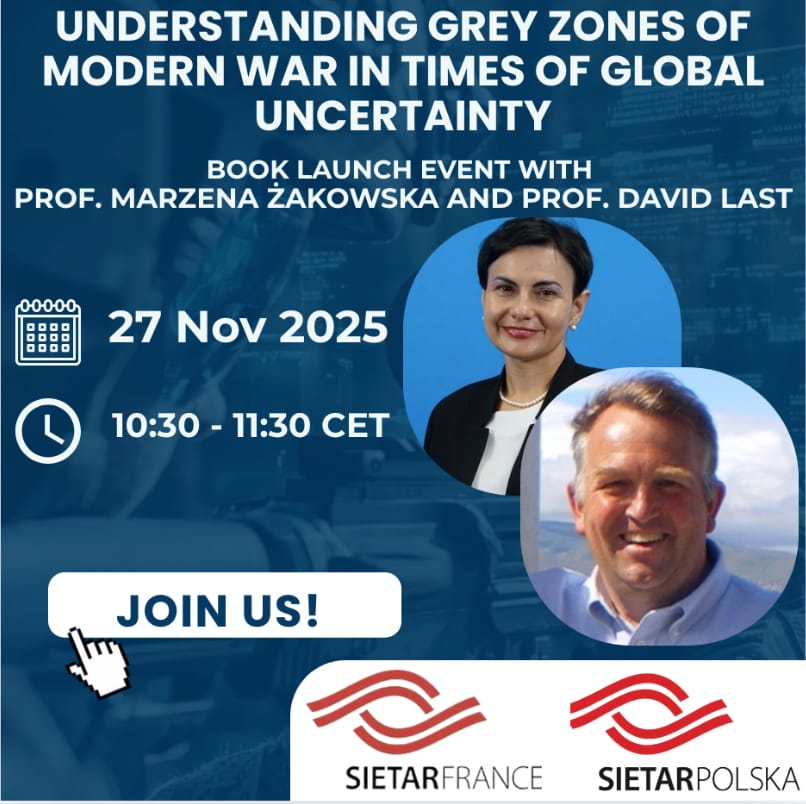
Webinar in collaboration SIETAR Polska and SIETAR France
“In today’s interconnected world, conflict rarely follows traditional patterns. Instead, we increasingly face grey zones—ambiguous spaces where war and peace overlap, and where hybrid threats blur the boundaries between military, political, cultural, and informational domains. These zones challenge not only states and institutions but also individuals, communities, and the very fabric of intercultural relations.
This lecture, based on the book Modern War and Grey Zones: Design for Small States (Routledge, 2025), explores how grey zones operate in practice, from disinformation campaigns and cultural manipulation to migration crises and identity struggles. It highlights why intercultural competence has become a critical skill in navigating global uncertainty, enabling us to recognize diverse perspectives, resist divisive narratives, and build resilience across borders.
For academics, trainers, and practitioners in intercultural communication, diversity, belonging, and identity, this session offers both conceptual insights and practical reflections. It invites dialogue on how the tools of intercultural practice can contribute to peace, security, and global solidarity in an age defined by ambiguity.
Problems to be addressed:
- Grey Zones as a New Global Reality
-
- What “grey zones” of modern war are—situated between war and peace, security and insecurity.
- How their existence reshapes our understanding of global social, migratory, and cultural processes.
- Diversity & Belonging in Times of Uncertainty
-
- How hybrid conflicts and grey zones undermine the sense of belonging and diversity.
- Intercultural Competence as a Tool of Resilience
-
- Intercultural competence not only in cross-cultural work, but also as a form of soft power against disinformation and division.
- The ability to recognize manipulation, practice empathy, and mediate in times of crisis.
Q&A Session: Invitation to Reflection and Dialogue
-
- How do SIETAR members perceive the role of intercultural competence in times of grey zones and modern wars?”
David Last is an Associate Professor of Political Science at the Royal Military College of Canada, a Commonwealth Scholar and Fulbright Research Chair, Secretary of the International Society of Military Sciences, and Co‑Chair of the Military and Police Relations Working Group of the European Research Group on Military and Society. He served in the Canadian Army for 30 years, including NATO and UN operations. He has taught political science and war studies at the Royal Military College of Canada and the Canadian Forces College since 1999. He has edited or co‑edited eight books and published over 80 chapters, articles, and reports on peacekeeping, conflict, and higher education. He has served on program and institutional evaluations for higher military education in Finland, Botswana, Namibia, South Africa, and Portugal. Since 2009, his research has focused on conflict management, taking a global comparative perspective on the contribution of security education.
Marzena Żakowska is an Assistant Professor at War Studies University in Warsaw, Poland. She holds a PhD in Security Science from the National Defense University in Warsaw. She holds postgraduate diplomas in Armed Conflicts and European Union Studies. She has completed advanced courses in conflict resolution at the Academy for International Conflict Management and Peacebuilding, United States Institute of Peace. She served as Vice Dean for Student Affairs and is now the Director of Global Affairs and Diplomacy Studies at the Faculty of National Security, War Studies University. Since 2018, she has chaired the War Studies Group of the International Society of Military Sciences. As a Postdoctoral Research Fellow, she collaborated with the Royal Military College of Canada and the US Army War College. She contributed to the NATO‑DEEP Hybrid Threats and Warfare Reference Curriculum. She collaborates with scientific journals such as the Small Wars Journal (SWJ–El Centro) and the Journal of Law and Politics. Her research emphasizes national security, war and armed conflicts, hybrid threats, security in the Western Balkans, and broader issues related to social security.”
Organised by Dr. Lidia Wiśniewska and Dr. Grazia Ghallini
Join us !